
Ask three people about peptides: a pharmacist, a longevity enthusiast, and a biohacker with impressive abs and a discount code.
The pharmacist might mention insulin. The longevity enthusiast might talk about natural peptides. The biohacker might recommend an experimental compound that supposedly optimizes metabolism, accelerates recovery, and helps you age backwards.
Same word. Very different realities.
It’s a little like comparing prescription glasses, night-vision goggles, and binoculars. All involve optics, but you probably wouldn’t use them interchangeably. Peptides deserve the same distinction.
1. Pharmaceutical Peptides: Evidence Before Enthusiasm
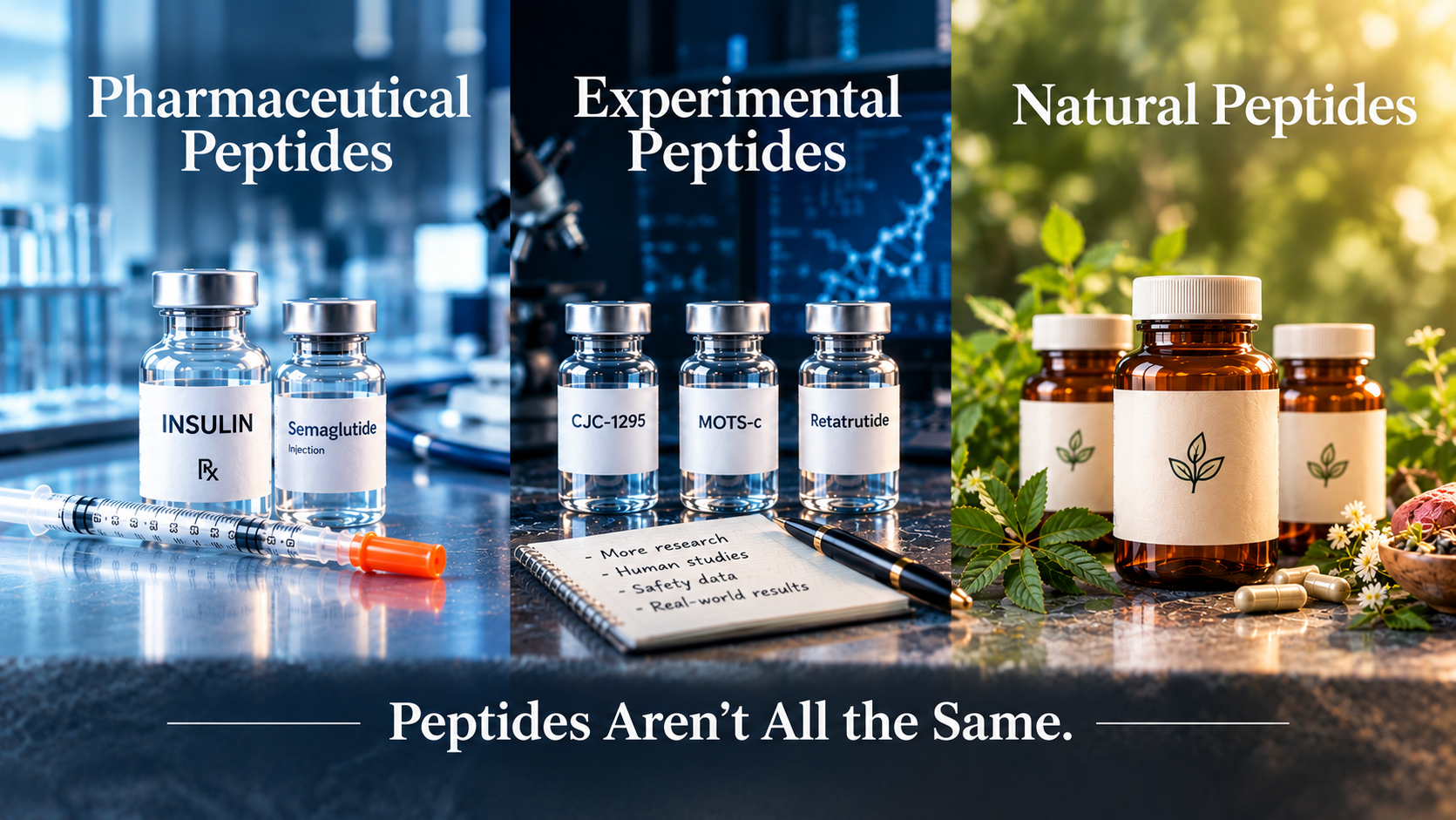
Pharmaceutical peptides include established medicines such as insulin and semaglutide. They are developed for specific medical purposes, with clinical trials evaluating their benefits and risks, and manufacturing standards designed to ensure consistent quality.
That doesn’t make them harmless. Every medicine has a risk-benefit profile, and the right treatment depends on the individual. But their use is supported by a level of clinical evidence and regulatory scrutiny that a compelling theory alone cannot provide.
In other words, these medicines have moved beyond “interesting idea” into carefully evaluated clinical practice.
Not quite as glamorous as a secret longevity hack, perhaps—but considerably more useful than a good marketing team wearing a lab coat.
2. Experimental Peptides: Promising Science, Unanswered Questions
This is where things get interesting—and where the internet occasionally starts writing prescriptions with the confidence of someone who watched two medical podcasts.
Consider CJC-1295, studied for its effects on growth-hormone signalling; MOTS-c, investigated for its potential role in metabolic regulation; and Retatrutide, an investigational drug targeting three hormone receptors involved in appetite and metabolism.
These compounds illustrate why the word experimental needs context.
CJC-1295 and MOTS-c have important unanswered questions around human use and safety. Retatrutide, by contrast, has progressed into large Phase 3 clinical trials and demonstrated substantial weight loss in studies. Yet it remains investigational, not an approved medicine.
The lesson? Experimental peptides do not all occupy the same rung on the evidence ladder.
A promising mechanism is a reason to investigate a compound—not proof that it will deliver the promised benefits. Researchers still need to establish which effects are clinically meaningful, who benefits, what the risks are, and how those risks may change with longer-term use.
And buying an unapproved compound online is not the same as participating in a carefully monitored clinical trial. Your biology deserves better than a mystery vial with excellent marketing.
3. Natural Peptides: A Category Worth Taking Seriously
Now let’s talk about a category that often gets overlooked in the peptide conversation: naturally-sourced peptides.
These preparations are associated with short peptides or peptide mixtures derived from biological tissues and marketed for their potential to support particular physiological systems. The underlying idea—that biological signalling molecules may influence cellular activity—is scientifically intriguing.
And there are reasons to investigate this area rather than dismiss it out of hand.
In my own practice, my experience with natural peptides has been encouraging, and I have not had anyone report side effects from their use. These are meaningful real-world observations, and they deserve to be part of an honest discussion.
At the same time, clinical experience is not the same as a controlled trial. The sensible approach is neither blind enthusiasm nor automatic dismissal. It is open-minded scrutiny.
Evidence must be assessed product by product. And natural peptides deserve thoughtful investigation, not a blanket verdict based on the word “peptide.”
The Real Question Isn’t Whether Peptides Work
It’s which peptide, for what purpose, supported by what evidence, and with what known risks.
Before accepting a peptide claim, ask three questions:
What exactly is the compound or preparation?
What does the evidence show in humans—not just in a laboratory or animal model?
What do we know about its safety, quality, and regulatory status?
The future of peptide science may be exciting. Some applications are established; others are promising; and some may never live up to the hype.
The goal isn’t to believe in every peptide—or dismiss them all. It’s to separate established science from promising clinical observations—and both from a marketing department running wild.
Curiosity is an asset. Critical thinking is a survival skill. And your biology deserves better than a sales pitch wearing a lab coat.
Stay vital,
Richard Labaki
Holistic Therapist / Longevity Architect